Steven Spielberg’s Disclosure Day opens today, and whatever one makes of UFOs, UAPs, aliens, disclosure, cover-ups, or government files, one thing seems fairly certain: the movie will stir up questions. Among the questions it raises are those that touch most deeply on faith and human dignity.
Some of them will be scientific.
Some will be political.
Some will be conspiratorial.
And some, inevitably, will be spiritual.
Are we alone?
If we are not alone, what does that mean?
Would the discovery of extraterrestrial life deepen faith, unsettle faith, or simply remind us that the universe was never as small as we imagined?
An Associated Press article this week explored some of those questions, especially the challenge that alien life might pose to religion. Some people see the possibility of extraterrestrial intelligence as a threat to traditional belief. Others see it as no threat at all. Still others fold the whole subject into older categories of angels, demons, revelation, and mystery.
I have no great theory to offer about aliens.
That may be a relief.
What interests me is not so much whether the truth is out there, but what happens to us when we imagine that it might be.
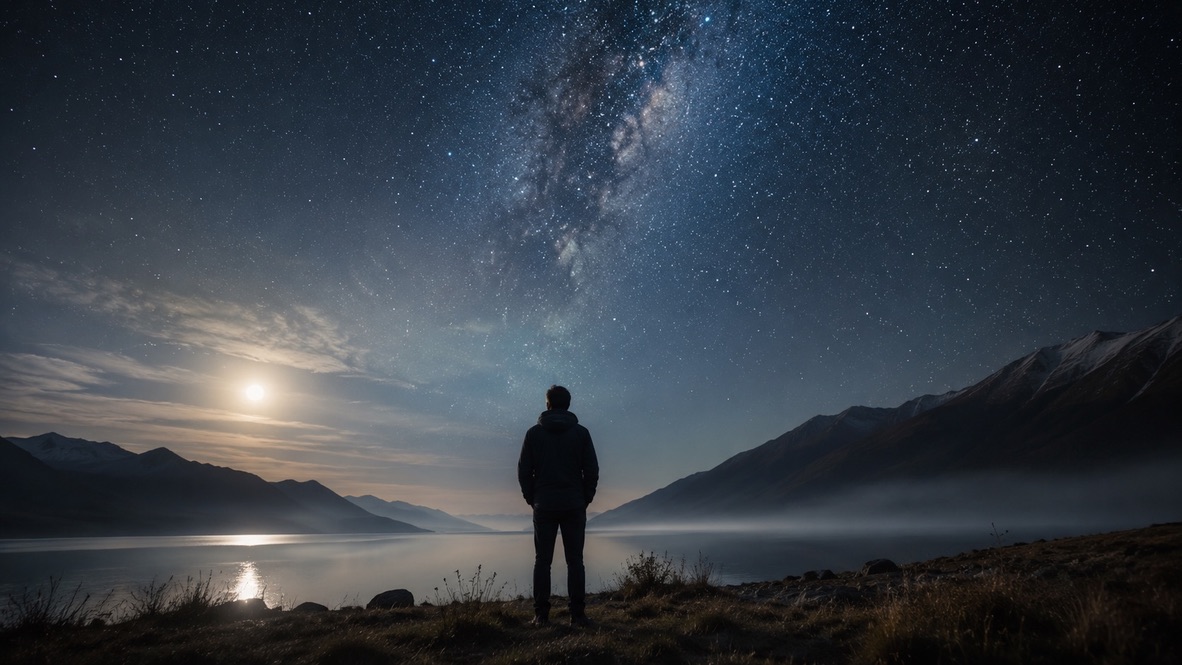
Because every so often, human beings are forced to stand under a larger sky.
We discover that the world is wider than we thought. The map changes. The old certainties loosen. The universe refuses to stay the size we need it to be.
And when that happens, fear is often the first visitor.
Fear asks: What if we are not special?
Fear asks: What if we are not central?
Fear asks: What if everything we believed has to be reconsidered?
Those are not foolish questions. They are deeply human ones.
Faith and Human Dignity in an Uncertain Universe
But I keep coming back to this: human dignity does not depend on being the only ones.
It does not depend on being the most powerful, the most advanced, the most knowledgeable, or the most impressive creatures in the universe. Dignity is not a prize for cosmic importance.
Dignity belongs to us because we are human.
This has been on my mind lately because of Pope Leo XIV’s recent encyclical Magnifica Humanitas. The encyclical speaks especially to the age of artificial intelligence, but its deeper concern is much wider: how do we safeguard the human person in a world being reshaped by powers we do not fully understand?
That question belongs to AI.
It belongs to medicine.
It belongs to politics.
It belongs to grief.
It belongs to the bedside.
And perhaps, in its own strange way, it belongs to any serious conversation about extraterrestrial life.
What happens to the human person when the world changes?
What happens to our sense of worth when we are no longer at the center?
What happens to hope when mystery grows larger rather than smaller?
I do not think mystery diminishes us.
If anything, mystery may humble us into a deeper reverence.
There is a kind of faith that needs everything nailed down, labeled, and defended. It needs the universe to behave itself. It needs God to fit within the boundaries of what we already know.
But there is another kind of faith that can stand beneath the stars and whisper, “There is more here than I understood.”
That does not make us less human.
It may make us more human.
In my work as a chaplain, I have learned that people do not usually need every mystery solved before they can be comforted. A grieving person does not need a complete theory of the cosmos. A frightened person does not need a lecture on certainty. A dying person does not need proof that they are useful, impressive, or central. This is where faith and human dignity meet: in the willingness to stay present to another person without needing to have all the answers.
They need to know they are not alone.
Perhaps that is the real human question beneath all the speculation.
Not simply, “Are we alone in the universe?”
But also, “Are we alone in our fear?”
“Are we alone in our grief?”
“Are we alone in our wondering?”
“Are we alone when the old answers no longer seem large enough?”
Hope is not the same as certainty.
Hope is the courage to remain human when certainty is not available.
And dignity is not reduced by the size of the universe.
Whether Disclosure Day turns out to be great cinema, summer entertainment, or just another spark in the long human fascination with the unknown, it may still offer us a useful invitation.
To wonder without panic.
To question without contempt.
To remain humble before mystery.
And most of all, to keep reverencing the life that is right in front of us.
The patient in the bed.
The child asking impossible questions.
The neighbor we distrust.
The stranger we are tempted to fear.
The person whose worth cannot be measured by usefulness, intelligence, productivity, strength, or certainty.
The universe may be larger than we imagined.
Human dignity is not smaller because of that.
Under the stars, under all that we know and all that we do not know, the old human task remains:
to see one another,
to care for one another,
to make room for wonder,
and to remember that every human life matters.
If these questions resonate with you, you might find more in our reflection on hope and dignity in chaplaincy work.