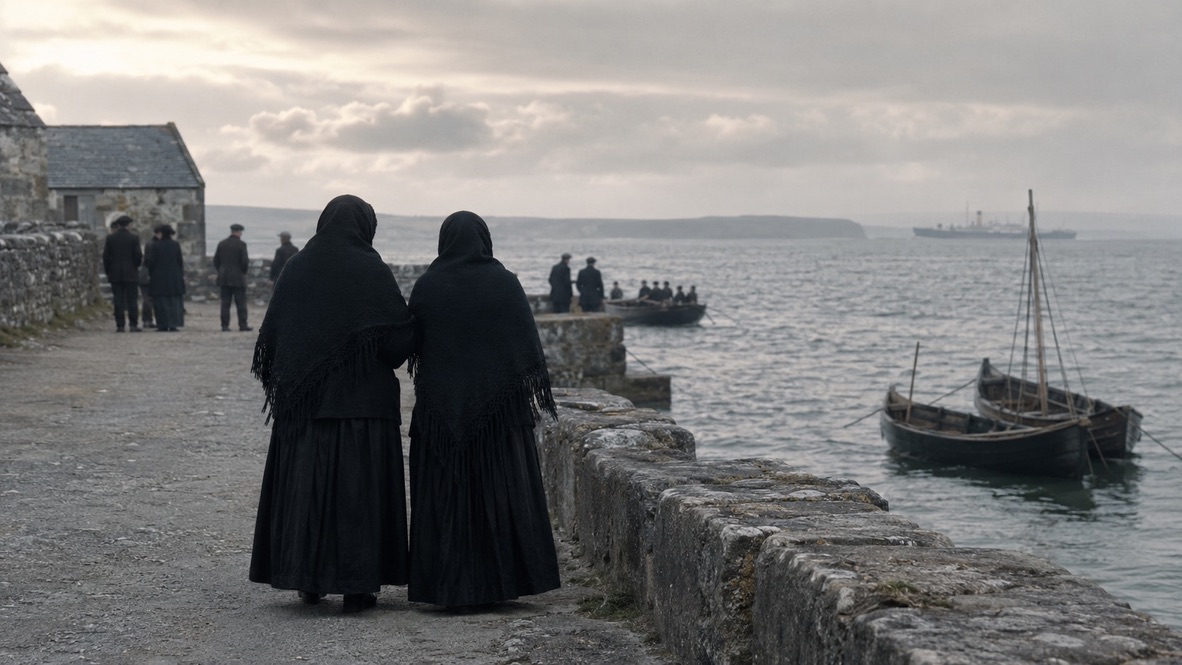
The Shawlies — on the dignity of sorrow
Dignity went with them. Máirtín Ó Direáin, “Dínit an Bhróin” / “The Dignity of Grief,” trans. Frank Sewell
There was an old woman who lived next to my grandmother when I was a boy in Cork. I remember her in a black shawl, the way the old women wore them then. Even then the custom was fading — I was young enough that she was one of the last I saw — but in my grandmother’s day they were everywhere, and the city had a name for them. The Shawlies — women who carried the dignity of sorrow where it could be seen.
I didn’t have the word as a child for what the black was doing. The shawl had been a common garment of working women once, but that world was nearly gone by my day — she was one of the last of them. What set her apart wasn’t the shawl so much as the black: she was never once out of it. Everyone in the lane knew she was a widow; she had lost her husband long before. The black was not a secret and not a disguise. It was her grief, kept where it could be seen.
Years later I came across a poem by Máirtín Ó Direáin, the great poet of the Aran Islands, called Dínit an Bhróin — “The Dignity of Grief.” In it he watches two women in black funeral clothes walk out of a crowd on a quay. A tender has come in from a liner anchored offshore; there is jostling and shouting, people rushing every way at once. The two women say nothing. They walk on together through the middle of it, and the poet sees what the hurrying crowd cannot: a kind of nobility in their silence. Dignity went with them. He saw on a quay what I half-remembered in the lane next door.
The Dignity of Sorrow in Irish Memory
There is an old root buried in the word widow. It comes down to us from a word meaning to separate, to be divided from — the same root that gives us divide. So at the very bottom of the word, a widow is one who has been parted from. The black shawl, the two women apart on the quay — the language was only telling the truth. Grief divides. It stands a person at a small distance from the world that goes on without pausing.
We have mostly put the black away now. No black armband, no drawn curtains, no sign worn where others can read it. We expect the bereaved back at the desk on Monday, composed, moving on. And so grief has gone indoors and learned to hide. Part of the dignity of sorrow that Ó Direáin saw in those two women was simply that their sorrow was allowed to be seen — and that the street still knew what the seeing asked of it.
The grieving do not need to be hurried back into the crowd. They need someone willing to stand a moment in the apartness with them — not to fix it, not to talk them out of it, only to let the grief be carried with the gravity it deserves.
She had been a widow many years by the time I knew her. The loss was long behind her, and still she wore it, and no one in the lane thought to wonder why she hadn’t moved on. She carried her grief the way she carried the shawl — as something that belonged to her, that no one would think to take. There was dignity in it.
You might also find meaning in exploring The Worth We Carry Within Us.